
Instrument Rating
What is an Instrument Rating?
An Instrument Rating (IR) is a supplemental pilot rating that allows a pilot to fly under Instrument Flight Rules (IFR).
This rating qualifies a pilot to operate an aircraft in clouds, low visibility, and adverse weather conditions solely by reference to the aircraft’s instruments.
Unlike a Private Pilot License, which restricts pilots to Visual Flight Rules (VFR) and requires visual reference to the ground, the Instrument Rating focuses on precision flying and situational awareness.
This qualification serves as a critical safety enhancement for hobbyists and a mandatory stepping stone for anyone pursuing a professional pilot career.
Is an IFR Rating Worth It?
For career-oriented pilots, the Instrument Rating is non-negotiable. Federal regulations require this rating for most commercial flying jobs, including airline transport and cargo operations.
For recreational pilots, the Instrument Rating offers significant safety and utility benefits. The rating allows a pilot to depart on schedule even when cloud layers or haze would otherwise ground a VFR pilot. The training also drastically improves precision, radio communication skills, and overall confidence in the cockpit.
How Long Does it Take to Get an Instrument Rating?
Most students complete their Instrument Rating in 2 to 4 months when training on a consistent schedule of 2 to 3 lessons per week. This timeline allows for steady progression in both simulator sessions and flight hours.
Students in an accelerated instrument training program can earn the rating in as little as 3 weeks. This fast-track option requires full-time commitment, with students flying or training in simulators multiple times per day.
What are the FAA Requirements for an Instrument Rating?
The Federal Aviation Administration (FAA) outlines specific eligibility and experience requirements for the Instrument Rating under 14 CFR Part 61 and Part 141.
General Eligibility Requirements:
- Hold at least a Private Pilot Certificate
- Read, speak, write, and understand the English language
- Hold a current FAA Medical Certificate or BasicMed
- Pass the FAA Instrument Rating Aeronautical Knowledge Test
Flight Experience Requirements (Part 61):
- 50 hours of Pilot-in-Command (PIC) cross-country flight time
- 40 hours of actual or simulated instrument time
- 15 hours of instrument flight instruction from an authorized instructor
- One cross-country flight of at least 250 nautical miles with three different approaches
Flight Experience Requirements (Part 141):
- 35 hours of instrument training (actual or simulated)
- 30 hours of ground training
- One cross-country flight of at least 250 nautical miles with three different approaches
Once you’ve met all of these IFR rating requirements, you take a practical exam (also called a checkride) that consists of both an oral question and answer session and a flight check. If you pass both, you’ll earn your instrument rating.
What Does Instrument Training Look Like?
Instrument training consists of one-on-one sessions with a Certified Flight Instructor – Instrument (CFII). Lessons typically run in 2 to 3-hour blocks and alternate between ground briefings, simulator sessions, and actual flight time.
During flight lessons, the student wears a view-limiting device (foggles) to simulate instrument meteorological conditions. The instructor acts as air traffic control and safety pilot while the student practices:
- Precision attitude flying
- Navigation using VOR and GPS systems
- Holding patterns
- Instrument approaches (ILS, RNAV, VOR)
- Emergency procedures in low visibility
Instrument Rating Program Overview*
Instrument Rating Includes:
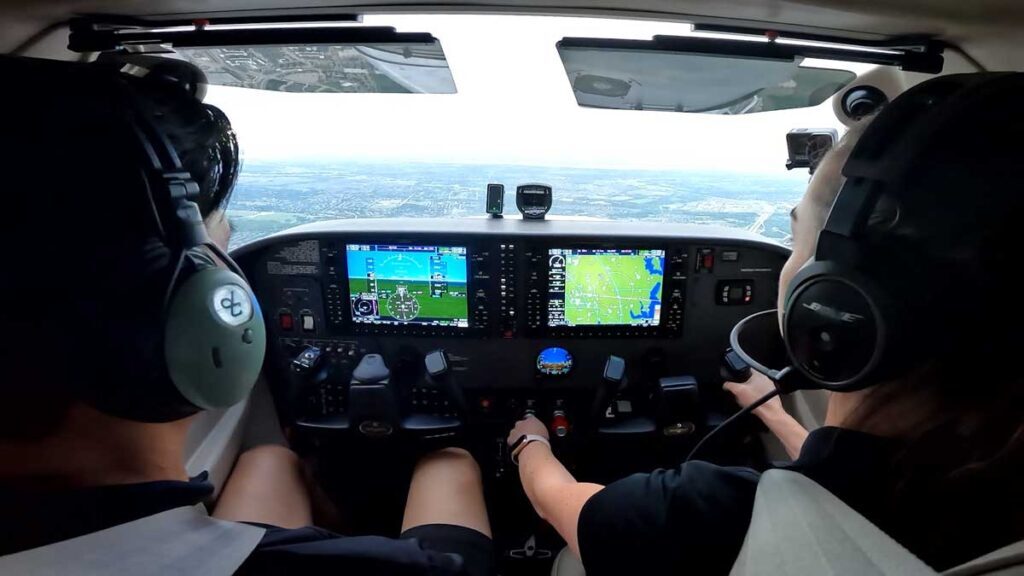
- 21 hrs. of dual flight training in an air-conditioned Cessna 172 with G1000 avionics suite
- 14 hrs. of RedBird full-motion simulator training
- 30 hrs. of personalized knowledge (ground) instruction
- Jeppesen Instrument Pilot Training System
- Pilot Syllabus
- Flight Bag
Prerequisites
- Hold at least a current private pilot certificate.
- Be able to read, write, and converse in fluent English.
- Hold BasicMed or 3rd class (or higher) medical certificate.
- Not a prerequisite but you may also want to attend instrument pilot ground school.
*We are not currently enrolling people in our instrument only program.
Looking to become an Airline Pilot? Contact us to learn more about our Zero Time to Airline Program.