

The Thrust Flight 2026 AI Career Security Report finds most workers would trade pay for a career AI can’t touch, but few know where to find one.
For years, automation fears centered on factory floors and warehouses, the jobs everyone assumed robots would take first. The boom and widespread use of AI has changed that. Now marketing teams watch software draft copy, customer service calls get answered by a bot before a person ever picks up, and anyone who spends the day writing, scheduling or building a spreadsheet has reason to wonder how much longer that work is theirs to do. The fear isn’t hypothetical anymore. It shows up in performance reviews, LinkedIn posts and conversations about what happens if the role isn’t there in five years.
What’s harder to determine is what people actually want to do about it. Most workers are running new numbers on what a secure career actually looks like, weighing the job they have against the one that might hold up better over time. For a lot of them, that math increasingly points to a job AI genuinely cannot do.
The Thrust Flight 2026 AI Career Security Report set out to measure that shift directly: how worried workers really are, and how much they know about the hands-on, licensed careers, aviation included, that are built to hold up against automation. The findings show most workers are already willing to trade pay for security. What’s missing is information about where to find that kind of career.
Purpose of this Study
The Thrust Flight 2026 AI Career Security Report was conducted in August 2026 via Pollfish among 750 U.S. full-time workers ages 18 to 80. The survey measured how worried workers are about AI affecting their jobs and what they want most from a next career, along with how familiar they are with hands-on, licensed career paths considered resistant to automation. The research was conducted by Thrust Flight, a leading U.S. aviation training provider for professional pilots, aircraft dispatchers and aircraft maintenance technicians.
Key Findings of the Thrust Flight 2026 AI Career Security Report
- 73% of workers agree most people will need a completely different skill set within ten years because of AI.
- 49% of workers are at least somewhat worried AI will change their own job that way.
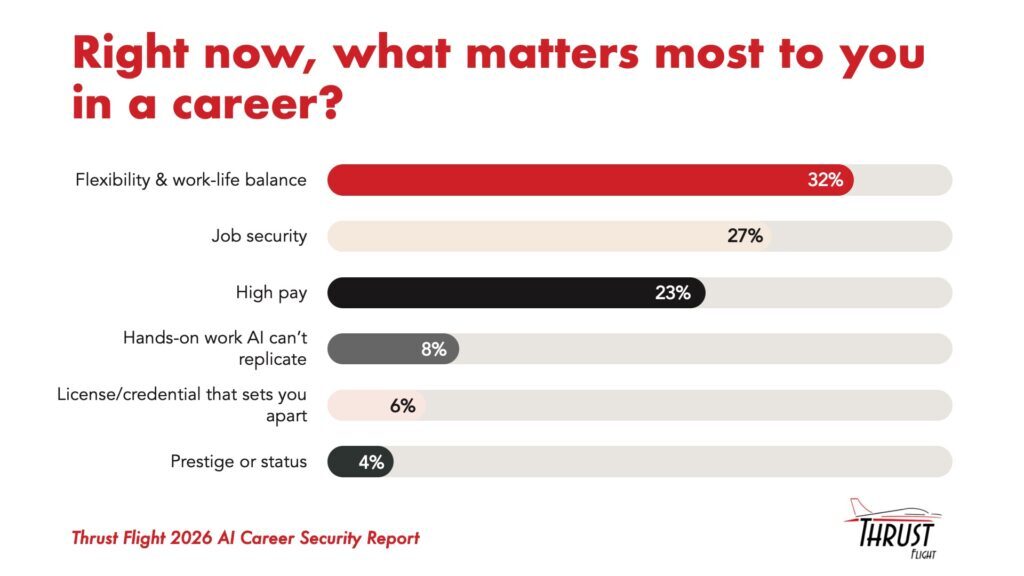
- 32% of workers rank flexibility and work-life balance as their top career priority. Job security ranks second at 27%, and pay follows at 23%.
- 59% of workers say they’d take a 10% pay cut for a career with guaranteed long-term job security, even if it meant physical or hands-on work.
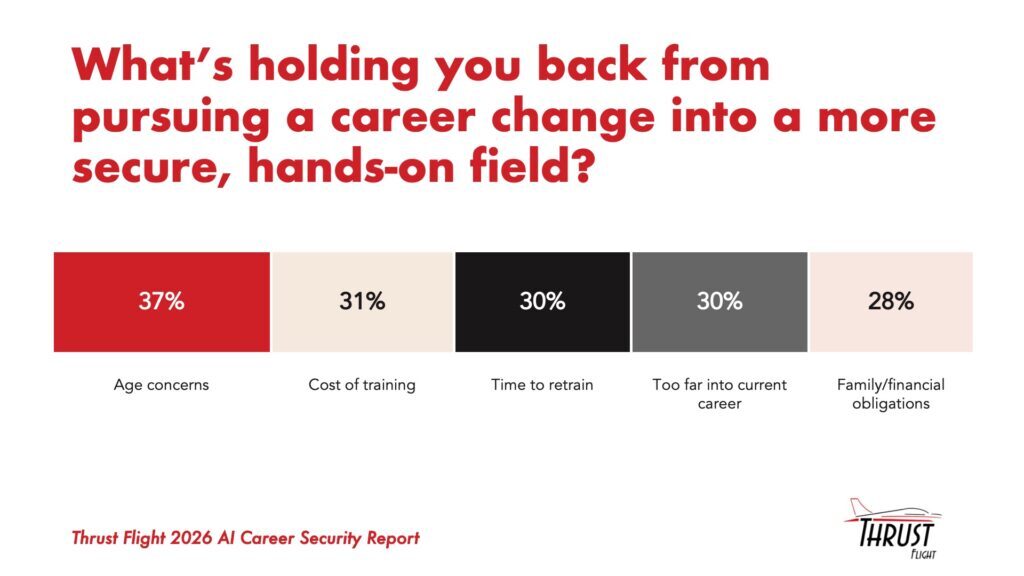
- 37% of workers cite age concerns as the top barrier to a hands-on career change. The cost of training follows at 31%, and time to retrain ranks third at 30%.
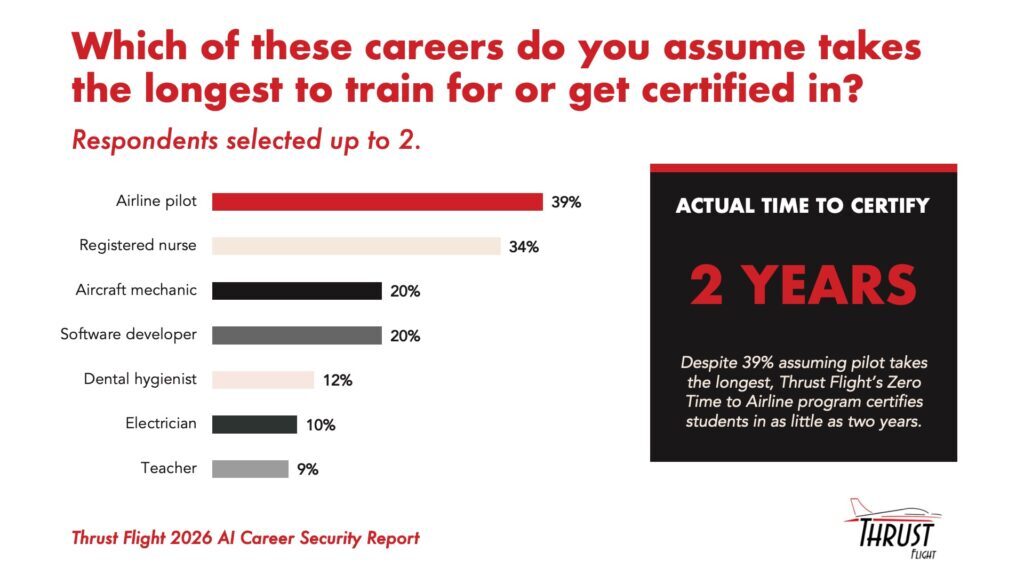
- 39% of workers assume an airline pilot position takes longer to train for or get certified in than any other career tested.
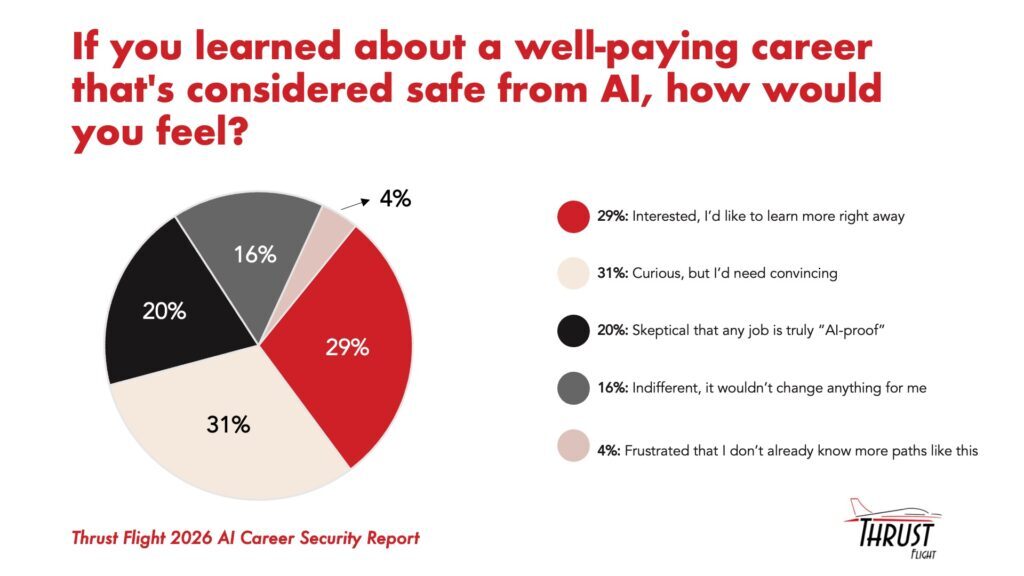
- 60% of workers say they’d be interested or at least curious to learn about a well-paying career considered safe from AI.
- 77% of workers say they’d likely suggest a hands-on or licensed career path to a friend worried about AI taking their job.
“Workers are being pragmatic about AI, running the numbers on what a secure career actually looks like,” said Patrick Arnzen, CEO of Thrust Flight. “What this survey found matches what we hear from students every day. They want to know their job will still be there in ten years, and most of them haven’t been shown what that career looks like or how fast they could get there.”
How Worried are Workers about AI Taking Their Jobs?
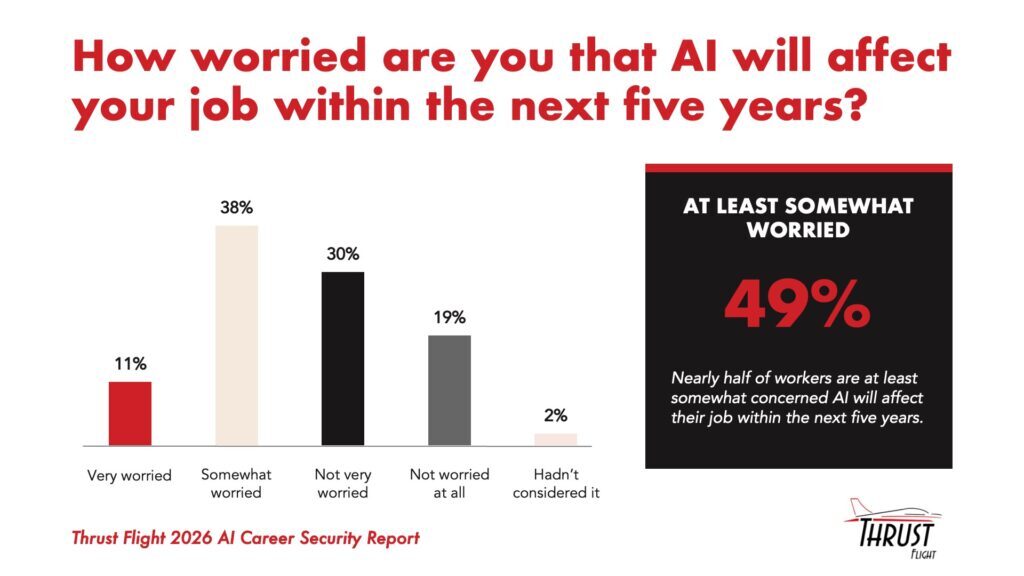
Nearly half of workers (49%) say they’re at least somewhat worried AI will affect their job within the next five years. Only 11% call it a real threat, and 38% describe themselves as somewhat worried but not panicking. That’s a workforce paying attention, without yet feeling cornered.
Nearly three in four workers (73%) agree that most people will need a completely different skill set within ten years because of AI, including 25% who strongly agree. That’s a bigger acknowledgment than expecting to lose a job. It means work itself is shifting for almost everyone, regardless of title.
The awareness hasn’t yet tipped into gloom. When asked to describe their industry’s future in a few words, 45% of workers picked optimistic and 42% picked hopeful, both well ahead of anxious at 17%. Workers seem to be holding two things at once: a real sense that change is coming, and a belief that they can come out ahead of it if they move first.
What Workers Actually Want From a Career Right Now (And What They’ll Trade for It)
Flexibility and work-life balance rank as the top career priority for workers today, at 32%, ahead of job security (27%) and pay (23%). That’s despite AI being the reason this conversation is happening at all: doing hands-on work AI can’t replicate and having a license or credential rank lowest of the six options tested, at 8% and 6%, well behind more familiar priorities like pay and security.
Security still shows up, more clearly once the question changes from what workers want to what they’d give up. More than half of workers (59%) say they’d take a 10% pay cut for a career with guaranteed long-term job security, even if it meant physical or hands-on work, including 21% who’d do it without hesitation. Only 32% say pay matters more to them right now.
Workers describe flexibility as the priority when asked in the abstract, but a majority will trade real money for security when the offer is concrete. A career that’s stable and lets someone build their own schedule checks more boxes than the wish-list answer suggests on its own.
What’s Stopping Workers From Switching to a More Secure Career
Age concerns are the biggest barrier workers cite to a more secure, hands-on career change, at 37%, with the cost of training (31%) and time to retrain (30%) close behind. Being too far into a current career (30%) and family or financial obligations (28%) round out the list.
Only 8% say nothing is holding them back, and 12% say they don’t know where to start. For most workers who haven’t switched, the calculation comes down to cost and time, and for a lot of career paths, that math doesn’t favor moving.
These are solvable problems. Cost and time in particular are questions a well-designed training program can answer directly. A career path that’s genuinely fast and clearly priced removes two of the top reasons people give for staying put.
Workers Think Pilot Training Takes Years. Here’s What It Actually Takes.
39% of workers assume airline pilot takes longer to train for or get certified in than any other career tested, ahead of registered nurse at 34%. Aircraft mechanic came in at 20%, tied with software developer. Dental hygienist (12%), electrician (10%) and teacher (9%) round out the middle of the list, while construction trades (7%), HVAC (6%) and police or firefighter (6%) sit near the bottom, seen among the fastest careers to enter.
That assumption works against aviation’s case as a next career, since workers are ruling it out based on a training timeline that doesn’t match reality. Thrust Flight’s Zero Time to Airline program takes students with no flight experience to a professional pilot certification in as little as two years, and its flight dispatcher training can be completed in about five weeks. Neither timeline matches what most workers assume going in.
That mismatch is where the barriers from the last section start to close. Time to retrain was the third-biggest reason workers gave for staying in their current career. If the real timeline runs in months instead of years, that barrier looks a lot smaller than workers currently think it is.
Is Aviation Considered Safe From AI? What Workers Actually Think
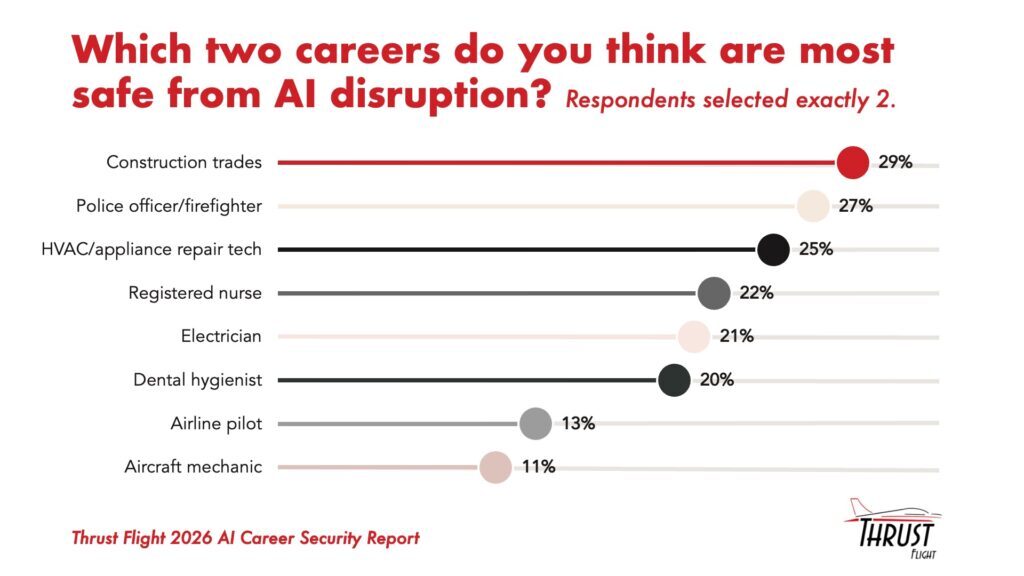
Construction trades lead the list of careers workers see as safest from AI, at 29%, followed by police or firefighter (27%) and HVAC or appliance repair (25%). Airline pilot comes in at 13% and aircraft mechanic at 11%, both well behind the trades and healthcare roles that dominate this question.
The picture shifts once a fast, licensed path is on the table. When workers were offered a career reachable in under two years with a clear licensing path, pilot (9%) tied construction trades (9%) and beat dental hygienist (7%), HVAC (7%) and police or firefighter (5%) outright. Aircraft mechanic (6%) edged out police or firefighter (5%) as well. Nurse (13%) and teacher (12%) still led the field, but pilot and mechanic held their own against several trades most workers already see as AI-resistant.
Getting aviation onto this list at all matters more right now than topping it. Most workers haven’t put piloting, dispatching or aircraft maintenance in the same mental category as construction or healthcare, even though the licensing, hands-on skill and pay line up the same way.
That underrating looks especially costly for mechanics. Boeing’s 2026 Pilot and Technician Outlook projects a global need for 728,000 new maintenance technicians over the next 20 years, more than the 674,000 new pilots projected over the same period. Thrust Flight CEO Patrick Arnzen expects that gap to bite by 2027, with the mechanic and instructor shortage becoming a bigger constraint on airline operations than the pilot shortage that dominated headlines from 2022 to 2025. Training providers like the Thrust Institute of Maintenance are working on solving this shortage actively. Workers who rank aircraft mechanic behind airline pilot on AI safety are underrating the career industry forecasts say needs people the most.
How Many Workers Would Explore a Career AI Can’t Touch?
A majority of workers (60%) say they’d be interested or at least curious to learn about a well-paying career considered safe from AI, split between 29% who want to learn more right away and 31% who’d need some convincing. Only 20% are skeptical that any job is truly AI-proof, and 16% say it wouldn’t change anything for them.
Workers extend that openness beyond themselves. More than three in four (77%) say they’d likely suggest a hands-on or licensed career path to a friend worried about AI taking their job, including 30% who say very likely. That’s a workforce ready to spread the message once someone delivers it.
None of that interest does much good if the information never reaches the people who’d act on it. For workers ready to hear about a faster, clearer path into aviation, Thrust Flight’s enrollment process and financing options are built to answer the cost and logistics questions before they become the reason someone talks themselves out of it.
What comes next for workers and the aviation industry
None of this requires workers to change what they want. They’re already saying they’d trade pay for job security, they’d consider a hands-on or licensed career, and they’d pass a recommendation like that on to a friend. What’s missing is an industry willing to show up with the timeline and the cost breakdown before someone rules a career out on assumption alone.
That puts the responsibility on training providers to close the gap. A program that can point to a specific timeline and a clear price has a real opening right now, especially for aircraft mechanics, where the demand data is strongest and the awareness gap is widest. Workers are already open to hearing it. The next move belongs to the industry.
“The finance and logistics of switching careers are real, but they’re solvable in months,” Arnzen said. “Once someone learns a flight dispatcher can be certified in about five weeks, or that a professional pilot career can start in around two years, the whole ‘AI-proof career’ conversation changes. Our job is getting that information in front of people before they’ve already ruled it out.”
Frequently Asked Questions About AI and Career Security
How worried are workers about AI affecting their jobs?
Workers are worried about AI affecting their jobs, with 49% saying they’re at least somewhat concerned about it happening within the next five years, according to the Thrust Flight 2026 AI Career Security Report. 11% call it a real threat, while 30% say they’re not very worried and 19% aren’t worried at all.
What do workers want most from a career right now?
Workers want flexibility and work-life balance most from a career right now, ranked highest at 32%, ahead of job security (27%) and pay (23%). Even so, more than half (59%) say they’d take a pay cut for a career with guaranteed long-term job security, even if it meant hands-on work.
What’s stopping workers from switching to a more secure, hands-on career?
Age concerns are what’s stopping most workers from switching to a more secure, hands-on career, cited by 37%, followed by the cost of training (31%) and the time it would take to retrain (30%). Only 8% say nothing is holding them back.
Do workers see aviation careers as safe from AI?
Workers don’t yet rank aviation careers among the safest from AI compared with other trades. Airline pilot (13%) and aircraft mechanic (11%) rank behind construction trades (29%), police or firefighter (27%) and other trades when workers pick the careers they see as safest from automation.
How long does it take to train for a career in aviation?
It takes far less time to train for a career in aviation than most workers assume. 39% think airline pilot takes longer to train for than any other career tested, but Thrust Flight’s Zero Time to Airline program can lead to a professional pilot certification in about two years, and its flight dispatcher training takes about five weeks.
Is there a shortage of aircraft mechanics?
There’s a shortage of aircraft mechanics, and industry forecasts project it will be more severe than the pilot shortage. Boeing’s 2026 Pilot and Technician Outlook projects a global need for 728,000 new maintenance technicians over the next 20 years, more than the 674,000 new pilots projected over the same period.
Would workers consider a career like piloting or dispatching if they knew more about it?
Many workers say they would consider a career like piloting or dispatching if they knew more about it. 60% are interested or curious to learn about a well-paying, AI-safe career, and 77% say they’d recommend a hands-on or licensed career path to a friend worried about AI.
Survey Methodology
The Thrust Flight 2026 AI Career Security Report was conducted in August 2026 via Pollfish among 750 U.S. full-time workers ages 18 to 80. The survey assessed how worried workers are about AI affecting their jobs and what they prioritize in a next career, along with how familiar they are with hands-on, licensed career paths considered resistant to automation, including aviation. The research was conducted by Thrust Flight, a professional pilot, aircraft dispatcher and aircraft maintenance training provider.